
Filtered by category: HEPI UK, tag: higher education × Clear

Gen Alpha is coming: what are three priorities for universities when resources are tight?
Dr Steve Briggs of the University of Bedfordshire outlines three priorities for universities preparing for Generation Alpha students arriving around 2030. First, updating academic practices to suit digitally native learners through blended learning, gamification and accessible content formats. Second, optimising existing systems, particularly around personalisation and AI tools available under current licences. Third, strengthening preventative wellbeing support, given Gen Alpha's exposure to global disruption, social media changes and AI-driven career uncertainty.

Are technicians a hidden indicator of teaching excellence?
Analysis of TEF 2023 submissions found universities referencing technicians in teaching excellence claims were twice as likely to achieve Gold ratings and three times less likely to receive Bronze. A third of providers mentioned technicians in 2023, up from a fifth in 2017. Researchers suggest technician visibility may indicate broader institutional cultures where teaching quality is shared across academic and professional staff rather than siloed within academic roles alone.

The ‘innovation nation’ needs its creative industries
UK creative industries contribute £145bn annually and grow at four times the national rate, yet remain largely excluded from innovation policy. Creative micro-firms lead on R&D activity but are locked out of HMRC tax relief, which requires science or technology advances. The article calls on the Budget to expand R&D definitions to include arts and humanities, simplify support for small creative businesses, and improve government collaboration with universities on creative start-ups.

AI is raising the first rung: Who will turn graduates into professionals?
Matched: Artificial Intelligence
AI is absorbing routine entry-level work that traditionally helped graduates develop professional judgement, disrupting the longstanding arrangement between universities, employers and professional bodies. Entry-level roles are becoming "seniorised," demanding leadership and adaptability earlier. The author argues universities must embed judgement-building across curricula, employers must replace the developmental value of routine work deliberately, and government should establish a formal graduate formation model clarifying responsibilities and funding — with equity in access a central concern.

AI and the humanities: crisis or opportunity?
Matched: Artificial Intelligence, generative AI
AI poses both a threat and opportunity to humanities education. LLMs risk devaluing degrees if students submit AI-generated work — professors identified it correctly only 53% of the time in one study. Yet graduates who develop genuinely human skills like critical thinking, ethical reasoning, and cultural understanding may become more valuable to employers precisely because AI cannot replicate these abilities. Universities should adopt assessments, such as oral exams, that cannot be AI-generated.

The next university crisis will not be about students using AI
Matched: Artificial Intelligence, generative AI
Universities have focused AI debate on student use, but the bigger risk is how AI is embedded in institutional operations — recruitment, administration, data, and decision-making. With 95% of students already using AI, universities now face a governance challenge: fragmented oversight, unclear accountability, and growing dependency without resilience. The author argues institutions must develop visibility, accountability, assurance, capability, and resilience before AI failures cause serious harm.

A missing opportunity in the higher education transformation debate
UK universities investing in transformation programmes are overlooking a key source of value: improving how staff actually work. Process mapping and cross-functional workshops before launching major changes can prevent costly mistakes, such as solving the wrong problem. Drawing on examples from policing and healthcare reform, the author argues that understanding real workflows across organisational boundaries is essential to effective transformation, and that staff experience and wellbeing are central to institutional performance, not incidental to it.
WEEKEND READING: Research may lose money. Cutting it could lose universities even more
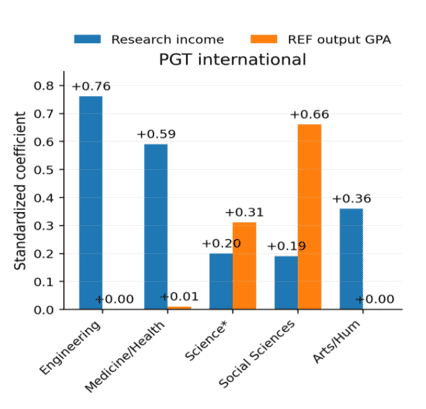
UK universities face a £6.18bn research deficit, with only 66.6% of full economic costs recovered. While cutting research may seem an obvious response, analysis of 16 research-intensive universities suggests this could damage international student recruitment. The relationship varies by discipline: in engineering and medicine, research income drives recruitment, while in social sciences, publication quality is the stronger signal — with one REF ranking place associated with roughly £13m in additional annual international fee income.
WEEKEND READING: Free speech, free labour and emeritus professors
The UK's Office for Students launched a free speech complaints scheme covering all former staff, but its press release specifically highlighted emeritus professors, prompting discussion about their ambiguous status. Emeritus titles are honorary with no employment rights, yet professors often expect continued library, email, and research facility access. Universities benefit from essentially free academic labour in return. Authors argue institutions should replace the informal arrangement with formal, time-limited contracts clarifying mutual obligations, or consider abandoning the title entirely.

Every student needs a minimum AI requirement
Matched: Artificial Intelligence, generative AI
A mathematics teacher writing for HEPI argues universities should treat AI literacy as an equality issue, not optional enrichment. While 95% of undergraduates use AI, only 48% feel staff are helping them develop relevant skills, and social-grade gaps persist. The author proposes a minimum first-term AI entitlement covering tool access, discipline-specific verification training, low-stakes practice, and clear assessment rules, suggesting this be embedded in existing access and participation plans.

‘Who’s looking after the researchers?’ The missing conversation in research culture
Matched: AI
Researchers studying difficult topics like domestic abuse, poverty, and trauma face significant emotional burdens that universities rarely address. A Warwick project found many researchers carry distressing experiences beyond working hours, yet receive little preparation for this. Early career researchers often fear admitting struggles. The authors argue researcher wellbeing should be embedded in ethics processes, training, and institutional strategy — not treated as optional.

Leading through disruption
Matched: AI
Higher education leaders face compounding pressures including financial restructuring, course closures, AI integration, and employer scrutiny. Research shows redundancies damage morale while leadership turnover accelerates. Drawing on Heifetz and Linsky's adaptive leadership framework, the article argues institutions focus too heavily on technical fixes while neglecting adaptive challenges — the human, cultural, and behavioural change required. Leaders are urged to name adaptive work explicitly in change plans and build sustainable support structures alongside operational ones.

Review of William Whyte: The University: A History in Stone, Silk and Blood
Matched: AI
William Whyte's book traces university history through its physical and material dimensions, exploring how institutions evolved from mobile medieval gatherings to established bureaucracies. Themes include recurring critiques of universities across centuries, the impact of new technologies, expansion pressures, and persistent forecasts of their demise — from the printing press to MOOCs — while universities continue to endure and adapt.

New HEPI and CUP&A Report: ‘Soft Power Index 2026’
Matched: AI
The 2026 HEPI/Cambridge University Press & Assessment Soft Power Index finds the US and UK together educated 126 current world leaders, with the US leading at 66 and the UK at 60. France ranks third with 29. Harvard, Oxford and Sandhurst top the institutional rankings. The 10th anniversary edition also examines how recent UK policy changes on international students could affect the country's long-term global influence.

WEEKEND READING: When prestige trumps skills: rethinking excellence in higher education
Matched: AI
Professor David Mba argues that England's skills system overvalues research-intensive universities as the benchmark for excellence, while undervaluing teaching-focused institutions that train nurses, teachers and other professionals. Using the NHS Graduate Guarantee as a starting point, he contends that producing qualified graduates is only part of workforce development — employment, deployment and retention matter equally. He calls for a broader definition of higher education excellence that recognises regional workforce contribution alongside research output.

WEEKEND READING: Points of convergence: the evolution of the UK Quality Code
Matched: AI
QAA's Dr Andy Smith traces the evolution of the UK Quality Code from the 1997 Dearing Report through successive iterations. Beginning as a 258-page, 175-precept Code of Practice, it was streamlined to a single A4 page in 2018 before expanding to an 18-page, 12-principle framework in 2024. The latest edition is now fully supported by nine newly published Advice & Guidance collections, completing a sector-owned resource co-created with colleagues across all four UK nations.